Saturday, January 26, 2019
A Digital Diet
A month or so possibly
Maybe a week
Without the mind candy that all of us seek.
A bit is okay
To eat every day
But never take too many bytes
With so many looks
And not enough books
To keep us up late every night.

Saturday, August 4, 2018
Online Talk is Cheap
Taken from: Trust Psychology – Nautilus Nov/Dec 2017
“Totalitarian societies know the power of common knowledge very well. When the Institute for Quantitative Social Science reveres-engineered the Internet censorship practiced by the Chinese government, they found that the government cared less about insults and criticisms than one might expect.
What it censored aggressively were social media posts making plans to meet in person. Online talk is cheap; but face-to-face people can build common knowledge.”
Stuart Firestein
“Totalitarian societies know the power of common knowledge very well. When the Institute for Quantitative Social Science reveres-engineered the Internet censorship practiced by the Chinese government, they found that the government cared less about insults and criticisms than one might expect.
What it censored aggressively were social media posts making plans to meet in person. Online talk is cheap; but face-to-face people can build common knowledge.”
Stuart Firestein
Postcard from Ellie - August 2018

Well, I have to tell you, in case you were worried. We made it to Finland. Mio and I had our first boat ride, a long one—about 13 hours I think. (I don’t wear a watch. I’m not into useless jewelry, but I do have an expensive collar, and some winter shoes in the closet.) I must tell you, neither Mio or me pooped on the whole boat trip. I am so proud, and it wasn’t easy. Oi! There was a place to poop on the ship, they call it the poop deck. I think most ships have them, or they used to. I don’t like bathrooms. They seem so unsanitary.
Here’s the best thing, I won 1st Place. Best Bitch! That is so cool. My first International. I am totally pumped, and Mio got a best junior ribbon. He is still young, but I’m helping him along.
It’s time for bed, and another contest tomorrow. Lighting does not often strike twice, but I don’t care. I am a happy hound. Best Bitch, I love it. Music to my ears. The tune does not grow old with reputation.

Online Talk is Cheap
Taken from: Trust Psychology
- Nautilus Nov/Dec 2017
“Totalitarian societies
know the power of common knowledge very well. When the Institute for Quantitative
Social Science reveres-engineered the Internet censorship practiced by the
Chinese government, they found that the government cared less about insults and
criticisms than one might expect.
What it censored aggressively were social
media posts making plans to meet in person. Online talk is cheap; but
face-to-face people can build common knowledge.”
Stuart Firestein
Sunday, July 29, 2018
What Women Want - Susan Pinker Comment

Susan Pinker developmental psychologist and author of The Sexual Paradox.
Taken from Nautilus Nov/Dec 2017
Thursday, July 5, 2018
Amsterdam – Part 3 - 4 July
Amsterdam – Part 3
I’m walking back from my graffiti tour and stop at a temporary bridge across the Oudezijds Achterburgwal canal, in front of my hotel. It’s closed to traffic now – dead water. My first time here in the Red Light District it was open, and wonderful. A constant stream of small boats full of happy people passing—waving, drinking, smoking, laughing – Having a time so good it was contagious.
The next year the city started repairing the canal’s century old walls. I remember waking up to a pile driver every morning and pretty much force out of my hotel during the day – because of the noise. They tore out dozens of beautiful trees that had lined the canal, old bridges were destroyed, and sidewalks. All this would be repaired, the city said. A year or two.
The two photos below were taken near the start, seven or eight years ago. This was my 2nd year in Amsterdam.
 On my 3rd year’s visit they began driving pilings. They’re big on
pilings. Amsterdam is built on ocean sand. You need a lot of pilings if
you want things to remain stable.
On my 3rd year’s visit they began driving pilings. They’re big on
pilings. Amsterdam is built on ocean sand. You need a lot of pilings if
you want things to remain stable.

It’s been an major project, and expensive. The big construction firms
doing work here are often from Germany and England – less expensive.
Things went well for a year or two, then progress stopped – for years
now. Only an ugly barrier remains in the water. Someone’s dared to climb
out on it and spray painted their initials. Graffiti.

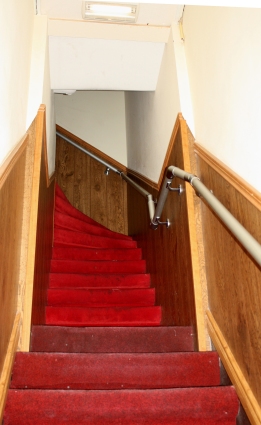
There are no elevators. Fourth floors are a four floor walk up. Stairs get narrower and corkscrew on their way to upper levels. You can see why furniture has to come in through the front windows. Rent goes from a thousand, or twelve hundred a month for these apartments, and they’re hard to get.
Bartender tells me work on the canal has stopped because of lack of funds. Other large projects in Amsterdam have met the same fate. Politics and money. Sad. The ducks and swans seem happy with the situation. Lots of new arrivals on the scene. I take a photo of a feathered family, then notice as I post this, the male has a ring of plastic trash stuck on his beak. I pray that he’s found a way to get it off.

I’m walking back from my graffiti tour and stop at a temporary bridge across the Oudezijds Achterburgwal canal, in front of my hotel. It’s closed to traffic now – dead water. My first time here in the Red Light District it was open, and wonderful. A constant stream of small boats full of happy people passing—waving, drinking, smoking, laughing – Having a time so good it was contagious.
The next year the city started repairing the canal’s century old walls. I remember waking up to a pile driver every morning and pretty much force out of my hotel during the day – because of the noise. They tore out dozens of beautiful trees that had lined the canal, old bridges were destroyed, and sidewalks. All this would be repaired, the city said. A year or two.
The two photos below were taken near the start, seven or eight years ago. This was my 2nd year in Amsterdam.
Very
big pilings. They drove a lot of them, eight hours a day. This photo
taken from the porch of my hotel. The window in my room looks out on the
canal below. Boom . . . Boom . . .Boom, and then a pause, and then
again. All day. Not fun to be around. I took some photos and got the
hell out of the way.
This is the canal today.
I’ve
heard two versions of the reason for work stoppage. The old buildings
(most from the 1700s) that line the canal are sitting on pilings – an
average of sixteen of them. Some say the canal project has shifted the
sand below causing some of the buildings to lean. Costs millions to fix
just one piling. Many of these old buildings seem to be
leaning, but they were built that way. The floors inside are level. In
photo below see hooks sticking out from the tops of buildings. These are
used to haul things up to the various floors. Slanted front prevents
things from bumping into windows on their way up.
Typical Stairway
There are no elevators. Fourth floors are a four floor walk up. Stairs get narrower and corkscrew on their way to upper levels. You can see why furniture has to come in through the front windows. Rent goes from a thousand, or twelve hundred a month for these apartments, and they’re hard to get.
Bartender tells me work on the canal has stopped because of lack of funds. Other large projects in Amsterdam have met the same fate. Politics and money. Sad. The ducks and swans seem happy with the situation. Lots of new arrivals on the scene. I take a photo of a feathered family, then notice as I post this, the male has a ring of plastic trash stuck on his beak. I pray that he’s found a way to get it off.
The
canal gets totally trashed every night, plastic. The sidewalks as well
are littered every morning. Jerks throw cans, bottles, and plastic into
the canal, or toss it on the sidewalks. Street cleaners start work at 7
a.m. and things look decent again by ten, when the tourists hit the
street.
Thursday, June 28, 2018
Things I Learn in Amsterdam - Part 2
Part 2 - Revision 1 July Sticker Price
I’m spending the afternoon with Terry, an interesting friend I met 12 years ago—my first time Amsterdam.
.
He’s an expat, like me — managing a coffee house now. He was a cook years ago, a stressful gig he chose to end. He goes to Columbia in the off seasons. Takes hang gliding lessons and is good at the sport. Can stay up for an hour, riding the thermals. Escorted by curious birds on occasion. Next year will be his final lesson.
“It’s called, Practice Falling— learning to survive a collapsed wing at 1000 meters.”
“Jesus. What if you screw up?”
“They do it over water.” Terry takes a bite of lunch. We’re at the Oriental Chicken — my favorite restaurant in Amsterdam. “. . . and there’s a boat below,” he says, “They pick you up.”
“How do you make the wing collapse?”
“You pull straight down on the straps. Like this.” He puts his hands at the sides of his hip.”
“How do you get it working again,” I ask.
He does a bird like thing with his arms. "You've got a few seconds to get it right."
I think of Icarus, but don’t mention it.
We take a walk after lunch and I ask him about stickers I keep seeing in different places.

“Where the hell do these come from, Terry? What are they?
“It’s graffiti, man.” He seems surprised I’m ignorant of this— I’m old.
“They’re from Sticker Artists. There are thousands of them—everywhere. You make a design, a sort of icon, and you get ‘em printed up—rolls of them. It’s a form of graffiti. Graffiti is expensive if you’re serious about it. Spray paint is expensive. You might need six or ten cans, just to do one painting —then some poster guy wallpapers over it.”
“Poster guy?” I’ve never heard of poster guys.
“They work on paper, and then paste their art to walls.”
“Amazing. All these mediums. I never knew. How much does it cost, for stickers?”
“Roll of a thousand stickers costs from fifty to two hundred Euros. Depends on what you want—how many colors. Do you want the back slit, so it’s easier to peel them off? The quality. You get a lot of them. Two thousand, maybe three. They go all over the world, these guys, pasting their stickers. Want to see a good graffiti shop?”
I nod my affirmation. I didn’t know there were such things. Some fifteen minutes later we are at the Montana Graffiti Shop—also known as, Henx. No idea what inspired these names. Most probably have meaning to it’s clientele. There is no name on the front.

I guess you are supposed to know—a sort of in thing.
Inside the place are thousands of cans—every color in the rainbow and some the rainbow never thought of. I’ve been trying to find some brown spray paint for some work I’m doing at home. Impossible. You can get black, silver, green and red, and white . . . that’s it. Photo below (1/3 of one wall of cans) shows a maker’s colors.

Paintings at top of this photo were done with spray cans.
Below see price of cans. There are all kinds of nozzles that can give the artists anything from a straight line to a blur. The paint is water based, but users are advised to wear gloves a mask for protracted use.

Stencils

They sell stencils. Stencil graffiti is the only graffiti I know a little about —the infamous Banksy. It should be Banksys. There is more than one, sharing the name. If the image takes your breath away, for one short moment . . . an imploding, wow. Then it’s a Banksy.
Seems a bit low bag to buy a stencil, but not everyone can be a Banksy—or Banksys. You can buy a stencil and plaster it everywhere. The skull below is a stencil. Noticed it on a wall not far from my hotel in the Red Light District.

Next Blog: Part 3 Noticing Graffiti
Subscribe to:
Posts (Atom)