Taking A Closer Look At Nothing
Taking a closer look at nothing
I’ve
been thinking a lot about nothing lately, and assumed I was pretty much
alone in this pursuit, but there are others, far more learned and
affluent than myself in search of nothing. These are serious and
expensive endeavors. Scientists spent 6 billion dollars and change to
build the Hadron Collider to help them look for nothing, or to find the
first thing
after there was nothing. How did something happen?
The
collider’s made of steel and concrete walls yards thick, a huge
galactic, microscope extremely good at finding questions, not so many
answers—lots of theories. Seems like understanding nothing should be
easy, but it’s not. The Hadron gooses protons ‘round it’s seventeen mile
track at near the speed of light, in temperatures hotter than the sun .
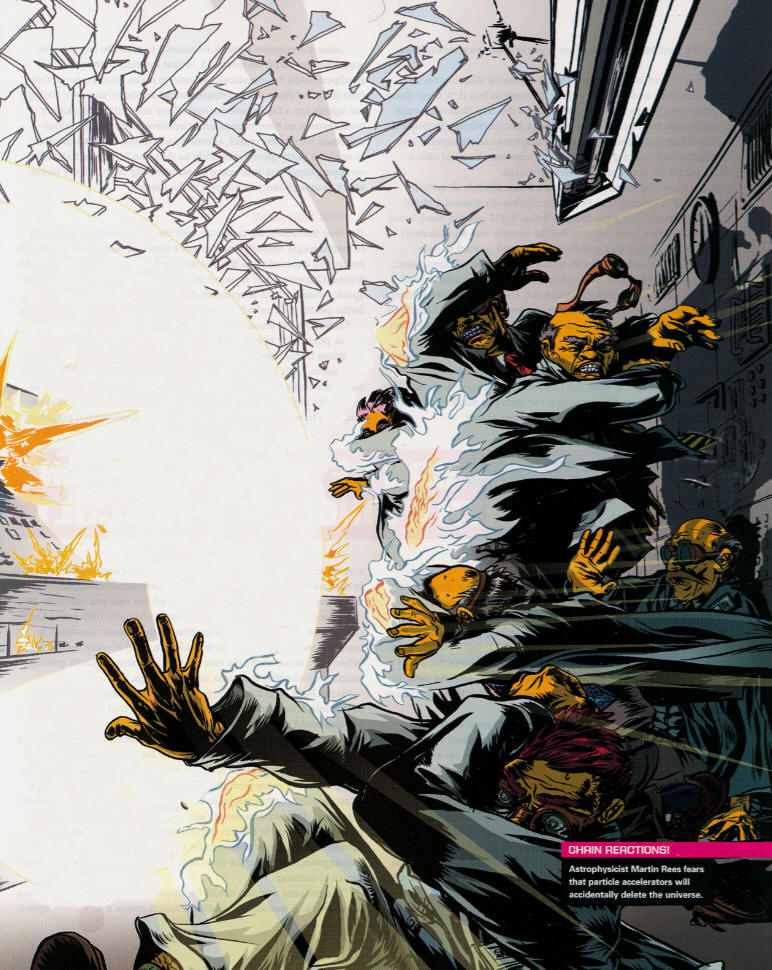
. . slamming them into one another. An atomic train wreck parts of
particles get splattered everywhere, smaller and smaller.
Particle Accelerator Accidently Deletes The Universe - Artist unknown
Protons
are whales in the subatomic sea of quarks, and leptons, pions, kayons —
bosons. We’ve been looking for a boson called the Higgs. ‘The God
Particle,’ scientists call it. The creator of matter. The thing that
made something possible.
We weren’t always sure we believed in the
Higgs, but the collider produced an enormous data base of collision
results, as many as grains of sand it would take to fill a swimming
pool. Out of this swimming pool of sand, they found less than a teaspoon
of Higgs bosons. But they did find some with the help of 80,000
computers interconnected in a private Internet. Now we believe in them .
. . I think.
The Boson is described as a field that glues
particles together, thus creating mass. Theorists suppose there might be
several kinds of Higgs, possibly five of them. They say it would
require more than a single cosmic task to glue the universe together,
and suppose a single Higgs is just a one trick pony. They’ll continue to
study the Higgs, or Higgses for years to come and probably discover
they’re made out of
something . . . else. When do we get to, “There is
nothing here.” It’s hard to believe in nothing.
Astronomers
are interested in nothing. They’ve been looking for it looking for it
with telescopes so powerful they can see into the past—time travel in
2-D. We can observe galaxies that existed when the universe was only 800
million years old. A long way back, but never quite to the beginning of
it all.
Some astrophysicists on coffee break decided to focus on a
spot in the universe where they were almost certain there was nothing.
The Hubble Ultra Deep Field Project
chose a black spot near the big dipper, its size visually comparable to
a grain of sand held at arm’s length—those grains of sand again. They
were astounded when the telescope revealed a megatude of galaxies.
Is
nothing possible? Seems like there’s always
something
left, but scientists predict they’ll find it sometime in the next ten
years. Better particle detectors will enable them to see even smaller
things, and finally that first bit of matter that appeared the moment
after nothing happened — when something appeared.
Sidebar:
After
hunting for the earliest clues about the evolution of the universe for
more than four years, Europe's Planck Space Observatory has gone dark.
Officials
with the European Space Agency sent the Planck observatory its final
command on Wednesday (Oct. 23, 2013), marking the end of its prolific
mission. The space observatory launched in May 2009 on a mission to scan
deep space for the faint relic radiation called cosmic microwave
background — the oldest light in the universe — created 380,000 years
after the Big Bang.
Next week: Almost nothing about something.