Total Pageviews

Tuesday, January 5, 2016

Observing Sweden – Öresund Bridge


Excerpts from: The Local.se – 4 Jan 2016


New border checks: traveler experiences

For the first time in half a century, Sweden is demanding photo identification for all rail travelers from Denmark as part of efforts to stem the flow of refugees between the two Nordic nations. The move is set to have an impact on 8,600 daily commuters who take the train over the Öresund bridge, as well as residents who use the connection to have meetings, shop or visit friends and family in Denmark and holidaymakers traveling around, to or from Scandinavia. The Local has spoken to some of those affected.

1. Nicholas Bean, British commuter
Bean, who works in marketing, only got a job in Copenhagen four months ago and described the changes as “really bad timing” for him, noting that his travel time was set to increase by up to an hour each day. The Briton, who is married to a Swede and has been living in Malmö for two years, said his first journey since the checks started had gone “pretty smoothly” on Monday morning, but that he was still disappointed in the government’s decision.
“The whole idea of it is ridiculous nonsense. It’s a sticking plaster on a problem that is much, much bigger,” the expat said. But he told The Local he felt it was “hard to not sound like an idiot” when discussing the impact on commuters because he was well aware that there were “people living in tent camps” and “thousands of others who want refuge and need to seek refuge” in Sweden in the coming months. “The checks are not going to stop people coming,” he argued.

2. David Nyman, Swedish visitor
After a night out in Copenhagen, Swedish journalist David Nyman was stopped from returning to Malmö at around 2am on Monday morning. He had failed to take his passport, national identity card or driving licence with him before the checks were introduced and attempted to persuade security staff that his press card should be considered adequate identification.
“I got denied because the guards argued that my press ID was not good enough as an ID card,” he told The Local. He said he was “tired and really wanted to go home” and decided to take a taxi instead, at the cost of 1,000 kronor ($118). “This money I will demand to get back,” he said. “I don’t think we should need ID documents to be able to travel between European countries.”

3. Rolf Olsson, Swedish pensioner
Olsson, 71, who lives in Malmö, is in favour of the checks, despite being a regular visitor to Copenhagen. “I think it’s good because we have far too many refugees in Sweden,” he told The Local’s reporter Richard Orange at Copenhagen’s Kastrup airport. “It has to start somewhere. At the beginning everybody complains and says it’s too tough, but after a month or so, everything will calm down. It should have been done a lot earlier.”
He argued that Sweden’s national government has not paid close enough attention to how the refugee crisis is affecting the country’s third largest city, which has long been a hub for immigrants.
“Stockholm doesn’t understand Malmö,” he said.

4. Per Tryding, Swedish businessman
A regular traveller between Malmö and Copenhagen, Tryding is deputy CEO of the Chamber of Commerce and Industry of Southern Sweden. He spent Monday morning at Copenhagen airport’s Kastrup train station, giving media interviews outlining his argument that the new border checks could have a major impact on business in the Öresund region.
“It felt like it was a diet version of the Berlin wall and it’s actually more intimidating than you think when you need to show your identity card like that to a guard and you know they are keeping it somewhere in a cloud,” he told The Local. “Three out of four trains have been cancelled as a result of the checks (…) The commuting system is the blood system of a metropolitan economy. It will stop the blood flowing.”

5. Emma Ohlin, Swedish train ticket vendor
25-year-old Ohlin works in a rail ticket office in Malmö in southern Sweden and says she is worried about her job becoming more stressful in the coming weeks. “Yes, since I meet many travellers who miss their trains in Sweden or demand compensation for cancelled trains,” she told The Local, adding that she was already fielding plenty of questions about the new rules.
“Generally I think it is a bad decision. The Öresund bridge was not designed for ID checks and I know many people who commute who are going to have considerably longer and more complicated journeys. I believe that it will affect the Öresund region in a negative way,” she said

6. Joakim Sandell, Swedish politician
The Malmö chairman of Sweden’s ruling Social Democrat party, Sandell, backs the national Red-Green coalition’s initiative, describing the new checks as “a must”.
“To reduce the refugee influx we believe that this is necessary,” he told The Local, noting that Sweden took in around 160,000 asylum seekers in 2015, compared to 18,000 helped by Denmark. He said he did not commute daily to Copenhagen but accepted that he would be personally affected by delays whenever he made the journey.

“There are about two parts of the criticism. One is that we are making it harder for asylum seekers in Sweden and the other one is how it is affecting businesses and train commuters. I have an understanding for both parts of the criticism,” he admitted. But he said that he felt no other Swedish political parties had come up with a better alternative solution and argued that “more European countries should have been taking more responsibility” during the earlier stages of the refugee crisis, when Sweden took in record numbers of new arrivals.

Sunday, December 27, 2015

Talking To Animals


Ellie Looking

Talking To Animals

How odd that people talk to pets
At home, at parks, or at the vets
They never answer
No response
Exactly what the human wants.

Sunday, December 20, 2015

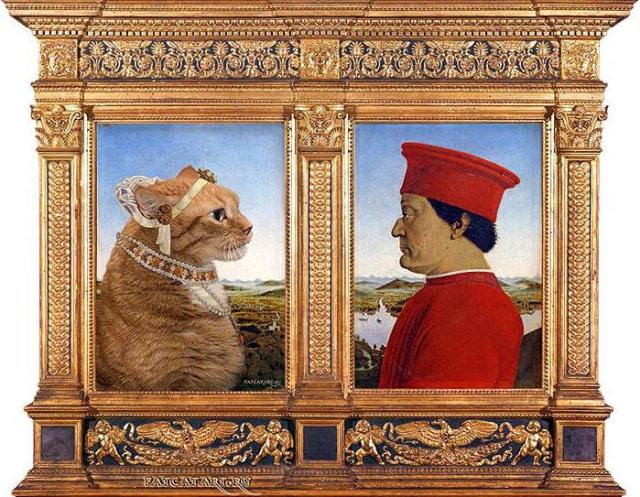
Kat Art - 11


Kat art 12 
FATCATART.RU

Observing Sweden - Realities


By Oliver Lane    29 Jul 2015

Sweden can be proud today to have shed its long standing reputation as ‘the most boring country in the world’. The Nordic state finds itself in the grip of a terrifying crime wave instead, which even ‘new Swedes’ describe as like “being back in Syria”.

Grenade attacks in multicultural paradise Malmö are now so commonplace the English-speaking media has all but stopped bothering to report them. Compounding the apparent disinterest in the descent of beautiful, historic Malmö into a third-world ghetto where native Swedes are very nearly in the minority, is a striking dearth of facts about what is actually going on there.

We know the grenade attacks are a regular occurrence – there have been four this past week and at least ten since April. They come in addition to the regular shootings, stabbings, and arson attacks that are apparently so commonplace they don’t make the English papers at all. A recent assessment by Malmö police into the effectiveness of their own violence-reduction program was that it had no effect, and that “the number of shootings and bombings in Malmö have not declined despite the measures”. The force today admitted it is severely under-staffed and unable to cope with the volume of investigations under-way. One third of all officers on the local force are now ‘on leave’, and no doubt the strain of the job in ‘Sweden’s Chicago’ is playing a part in that.

But there are scant few assessments by the Malmö police over who is deliberately targeting government buildings with hand grenades smuggled from the Balkans. The Swedish press reports no arrests. The closest to publicly expressed logic for the attacks is the suggestion that friends of three young men who set off a series of bombs in the city on Christmas Eve are now expressing their displeasure at the justice system, as all three were later jailed.

Benefiting from their youth – one was just 15 at the time of his arrest – the bombers have not been named, denying the public another crucial piece of the puzzle. Yet speculating that Malmö’s new-found crime problem may have anything to do with the sudden rush of immigration is verboten.
Don’t be fooled, for all its friendly press the Swedish orthodoxy is one of the most suffocating, and strongly upheld belief systems in the world. Until very recently, even questioning the doctrine of mass immigration would lead to total social exclusion.

Yet despite this, the tide is turning – slowly.
A number of shocking recent cases in Malmö and elsewhere go some way to explain the sudden and silent rise of Sweden’s new right-wing. The abduction and week-long gang rape ordeal of a young Swedish woman by a gang of Afghan men – who couldn’t even speak Swedish – should be enough to challenge the preconceptions of even the most dedicated multiculturalist.
If an overriding desire to care for persecuted immigrant communities is your thing, perhaps the needless abuse and persecution of Syrian Christians by Syrian Muslims after establishing themselves in Sweden could trigger a re-assessment of your political priorities.

This months a group of two Syrian Christian immigrant families were forced out of their Swedish asylum accommodation by Muslim residents. They were told they were not allowed to wear Christian symbols or even to use the communal areas when Muslims were present.
Instead of reporting the incident to the police, the Swedish immigration authority decided to deal with what they acknowledged were “fundamentalist Muslims” in-house, sending ministry officials to meet with the Muslim families at the asylum center to explain to them the fine points of Swedish law, hoping they would not transgress again.

A growing number of Swedes are starting to reject this way of doing things. Ashamed that ‘boring’ Sweden now has one of the highest rape rates in Europe and a growing teenage gang-rape problem, ashamed that they pay 60-per-cent income tax yet newcomers are showered with freebies, they look for an alternative.

The Sweden Democrats (Sverigedemokraterna, SD), the socially conservative anti-immigration party who campaign on the slogan ‘Keep Sweden Swedish’ continues to go from strength to strength. It now enjoys poll ratings that put it in place to become the nation’s third party. As is the case with other anti-immigration parties across Europe, SD enjoys its strongest support in areas with high levels of immigration, in this case in the more urban south.

The party polls consistently well in Malmö, suggesting those Swedes who still live there are desperate for change. The experience of Nordic sister Denmark suggests there is hope for the future.
After winning the most members of parliament in the June general election, the Sweden Democrat-like Danish People’s Party (Dansk Folkpartei, DF) is now clearly setting the national agenda despite sitting on the fringes of the now ruling centre-right ‘blue’ coalition. Only weeks after the electoral dust settled, the real optimism of a nation which is suddenly seeing real change is clearly apparent.

mALMO mOSQUE 

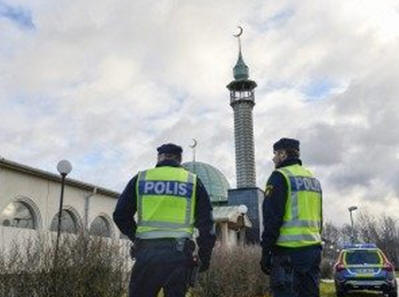
Swedish police patrol by a Mosque near Stockholm, the capital city / Getty

Just a fortnight after the election, Denmark cancelled unemployment benefits for migrants. Instead, they could receive a new ‘integration benefit’ worth half as much as the old unemployment money – and would only be eligible to claim the new full amount if they learn Danish.
Following up on the move, the Danish government announced last week that this change in money available to newcomers would be ‘advertised’ in the newspapers of countries like Turkey, to make sure those considering making the journey across Europe to Denmark knew not to bother.
The Swedish are learning from their Danish counterparts, and are adopting the same tactics. As the Danes did in 2011, the Swedish right-wing has taken on the nose the recent ‘victory’ by the left-wing in the 2010 elections.

They can stand confident knowing the left-wing Social Democrats, for whom support is falling, have been forced into leading a weak minority government while support for the new right-wing party is surging. And just like in Denmark, come the next election they will be perfectly placed to make the difference their country needs.

Sunday, December 13, 2015