Total Pageviews

Sunday, August 30, 2015

Robert Crumb's Birthday


Taken from Writer’s Almanac – 30 August 2015

It’s the birthday Robert Dennis Crumb, born 1943. His father was a combat illustrator for 20 years while serving in the Marines. Crumb’s mother was addicted to diet pills. It was an unhappy marriage. The family moved to Milford, Delaware, when Crumb was 12. He was dyslexic and had a hard time reading, so he preferred television and comic books, especially Little Lulu, Donald Duck, and Peanuts. Crumb said: “There were no books in our house. There were trashy magazines: my mother read movie and detective magazines. My father read the paper and that was it.”

His older brother, Charles, taught him to draw, and they spent hours drawing their own comic, called Foo, which they tried to sell to neighbors for 10 cents apiece. Because of his dyslexia, it took Crumb a long time to write the text, which may be why his later work tended to be more “literary” than work by other cartoonists. “I take the time to think out how to articulate things,” he said.

Crumb never went to college, or to art school. He went to Cleveland, instead, and began drawing novelty greeting cards for the American Greetings Company. He met other artists like Harvey Pekar, who would someday create the comic American Splendor, and Buzzy Linhart. His interest in jazz grew; he spent weekends haunting junk shops for old 78s. He became enamored of 19th-century engravings and graphic styles, and changed his drawing technique to one of cross-hatching. He was 19 and he walked the streets in an Abe Lincoln frock coat and stovepipe hat. Crumb said: “I was a teenage social outcast. At the time, it made me feel very depressed. Later, I realized I was actually quite lucky because it freed me. I was free to develop and explore on my own all these byways of the culture that if you’re accepted, you just don’t do.”

He began taking LSD in Cleveland, which profoundly affected his style and life view. One night he met two friends in a bar and, on a whim, with just pocket change, went with them to San Francisco, where he fell in with the artists in Haight-Ashbury. He sold his comics from a baby carriage and caught the eye of Janis Joplin, who asked him to illustrate the cover for her band’s next album. Overnight, it seemed, his characters of Mr. Natural and Fritz the Cat were everywhere. His most popular imagery, though, came from a Blind Boy Fuller song: the long, legged, grinning men adorned by the phrase “Keep on Truckin’,” which became the symbol of hippie optimism. Toyota offered him $100,000 to use the imagery in an ad campaign, but Crumb said no. “Keep on Truckin’!” is the curse of my life! I didn’t want to turn into a greeting card artist for the counter-culture! That’s when I started to let out all my perverse sex fantasies. It was the only way out of being America’s Best-Loved Hippie Cartoonist.”

Crumb has lived in the South of France for the past 25 years, still using Strathmore vellum surface paper and Pelikan black drawing ink. He works at an old printer’s light table and uses a magnifying glass for the details. “I work in erratic spurts. Getting started is like getting a rocket off the ground. You need the most energy and the most push to get started; once you’re up there and you’re going, then it’s easier to keep going. Sit down and pick up where you left off, you know. Getting going is always tough.”

Friday, August 28, 2015

Friday At Last


Friday at Last

I sent out invitations
to summon guests.
I collected together
All my friends.
Loud talk
And simple feasting
Discussion of philosophy
Investigation of subtleties.
Tongues lessened
And minds at one.

 
Cheng-Kung Sui

Saturday, August 22, 2015

Great Men


No Photo
Names and faces

“Great men are almost always bad men.” Quote: John Dalbergd-Acton, a historian, been dead a hundred years now. His definition had nothing to do with morality, wisdom, or great accomplishments. He was thinking of ‘great’ in terms of size, and power, fame and wealth. Who are the ‘great’ men we remember without effort to recall? My memory is not so good as it never was – always iffy. Not so good at faces either, may or may not recognize a neighbor in a crowd. What famous faces do we all remember? Hitler – easy with that funny mustache. Stalin, Lincoln, Washington, and Jackson . . . maybe. Helps to have your face on money. Faces I see every day . . . almost, Obama . . . Hillary.

Who’s face do I see the most these days? Without a question, Donald Trump. The man’s a genius, and a temporary (who knows?) ‘great’ man who has captured our mass media attention. We recognize the famous face seen every day, and night, on TV news, on Face book, magazines. That hair, as good as Hitler’s mustache ─ trademark, brand, he’s called it. If tomorrow were election day and you asked the people what Republican they thought might win. What names would be remembered? I don’t know, except for one, who wishes he could expedite the next election.

It’s the Brer Fox ploy if you remember that old tale, the rabbit pleading, “Only please, Brer Fox, please don’t throw me in that brier patch.”
Don’t hurt me. Please don’t make fun of me. Please don’t ridicule my hair – especially on TV. He made the cover of New Yorker. A cartoon, of course. We can’t escape the face gone viral. We are told it just about to wind down, just like Ross Perot, a much more modest man. The pundits probably have it right . . . I think. Let’s hope he’s not just winding up.

I watched his Alabama thing last night, when it was 3 A.M. in Sweden. Well worth staying up for. Things you notice: He does not sound like a politician, it’s like listening to the guy that lives across the street. No more or less intelligent. Such simple words and plans that anyone can understand without a second thought. It might be better not to have that second thought.

He spoke of Anchor Babies, wants to build a wall, a better, stronger army. Favorite book – the Bible. “I am not a nice person,” he told better than 10,000 people at his rally, which was on the TV news, seems like almost an hour. Who gets that kind of coverage? Pundits pro and con made comments after, wrangling over Anchor Babies, and political correctness. One said she had never heard the term before. This is the kind of rhetoric were all familiar with.

I think about the ways ‘great’ men have come to power in the past. Remember Hitler’s early speeches, how he planned to rebuild Germany, create a stronger army.

We live in interesting times.

Sunday, August 16, 2015

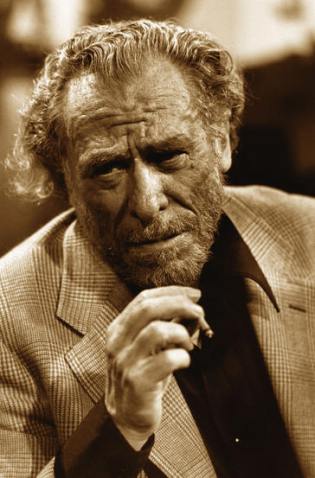
Bukowski's Birthday


Charles Buk


Today is the birthday of Charles Bukowski, who The Washington Post called, “The poet laureate of sour alleys and dark bars, of racetracks and long shots.” Born in Andernach, Germany (1920). He wrote more than 45 books of poetry and prose, including It Catches My Heart in Its Hands (1963), Notes of a Dirty Old Man (1969), Post Office (1971), Love Is a Dog from Hell (1977), Ham on Rye (1982), and The Last Night of the Earth Poems (1992).

His American father had been stationed in Germany during World War I, and Bukowski was the product of the man’s affair with a German girl, whom he later married. The family moved to Los Angeles when Charles was a toddler. He was picked on for his small size and his German accent, and when he was a teenager, he had such bad acne that it left permanent scars. His father had a violent temper and used to beat him. Bukowski was 13 when a friend gave him his first drink. Bukowski, said, “This is going to help me for a very long time.” He studied journalism in college for a couple of years, but then dropped out when World War II started, and he moved to New York to become a writer.

He published his first story when he was 24; the story was called “Aftermath of a Lengthy Rejection Slip.” The rejection slip in the story reads, “Dear Mr. Bukowski: Again, this is a conglomeration of extremely good stuff and other stuff so full of idolized prostitutes, morning-after vomiting scenes, misanthropy, praise for suicide etc. that it is not quite right for a magazine of any circulation at all. This is, however, pretty much a saga of a certain type of person and in it I think you’ve done an honest job. Possibly we will print you sometime, but I don’t know exactly when. That depends on you.” Bukowski would later estimate that his work was 93 percent autobiographical.

He published one more story after that but then received rejection after rejection, and he gave up writing for 10 years. He drank his way from New York to L.A., and wound up in a hospital, half dead from a bleeding ulcer. The doctor told him, “If you have another drink, it will kill you.” Bukowski kept drinking, and he worked a series of odd jobs – at a pickle factory, a dog biscuit factory, a slaughterhouse, and at the post office. When he was 35, he started writing poetry. His first collection was called Flower, Fist, and Bestial Wail (1959). Ten years later, when he was 49, Bukowski accepted a job offer from John Martin, the publisher of Black Sparrow Press. Martin idolized Bukowski, and had started Black Sparrow with the sole aim of publishing his work. Martin was sure he was the next Walt Whitman, and he offered him $100 a month to quit his job and write. “I have one of two choices – stay in the post office and go crazy … or stay out here and play at writer and starve,” Bukowski wrote in a letter. “I have decided to starve.” In return for Martin’s faith and support, Bukowski published almost all of his major work through Black Sparrow from then on.

Bukowski summed up his philosophy in a letter he wrote in 1963: “Somebody […] asked me: ‘What do you do? How do you write, create?’ You don’t, I told them. You don’t try. That’s very important: ‘not’ to try, either for Cadillacs, creation or immortality. You wait, and if nothing happens, you wait some more. It’s like a bug high on the wall. You wait for it to come to you. When it gets close enough you reach out, slap out and kill it. Or if you like its looks you make a pet out of it.


Saturday, August 15, 2015

Berlin Wall


B Wall Graffitti Fixed 

Grafitti on remaining section of wall.  20th Anniversary of the fall – 2011

(Click to enlarge)

Construction of the Berlin Wall began on this date – 1961. After World War II. Berlin lay completely within Soviet territory, but it was also divided. Soviet forces controlled the eastern part of the city and the country, and they were increasingly concerned about locking it down against the democratic West. The border was porous after the war, and millions of East Germans immigrated west in search of greater opportunities. By 1961, they were leaving at a rate of a thousand per day.

In the early hours of August 13, 1961, East German soldiers quietly began laying down barbed wire inside the border of East Berlin. People woke up and discovered that they had been separated from families and jobs, with no advance warning. And two days later, on this date, the government of East Germany began to replace the wire with a six-foot block wall. People still tried to escape, even after the wall was raised to ten feet. About half of them made it. West Germany wanted the United States to do something, but President Kennedy was reluctant to act. He told his staff, “It’s not a very nice solution, but a wall is a hell of a lot better than a war.”

Finally, in 1989, with the end of the Cold War, the gates between East and West Berlin were opened again. Over the next year, souvenir hunters known as Mauerspechte, or “Wallpeckers,” began chipping away at the wall, knocking off blocks with sledgehammers and climbing back and forth over it. The wall was formally dismantled, and Germany reunified, in 1990.

Thursday, August 6, 2015

Handy Man - by Barton Sutter


I can’t resist reposting this from Writer’s Almanac. Sounds so much like life.

Handyman
by Barton Sutter

The morning brought such a lashing rain
I decided I might as well stay inside
And tackle those jobs that had multiplied
Like an old man’s minor aches and pains.
I found a screw for the striker plate,
Tightened the handle on the bathroom door,
Cleared the drain in the basement floor,
And straightened the hinge for the backyard gate.
Each task had been a nagging distraction,
An itch in the mind, a dangling thread;
Knocking a tiny brass brad on the head,
I felt an insane sense of satisfaction.
Then I heard a great crash in the yard.
The maple had fallen and smashed our car.

"Handyman" by Barton Sutter from Farewell to the Starlight in Whiskey. © BOA Editions, 2004.

Sunday, August 2, 2015

Observing Sweden - Crayfish Parties


Strange Swedish Customs


It’s Swedish Crayfish party time again. Most of the crayfish come from China, which in itself is strange, and a bit scary. Swedish crayfish are considered a delicacy and very expensive . 

There's still much to learn, but this is only my 3rd party. I can manage to open the main section of the crayfish, but claws . . . forget about it. It’s like trying to skin an armadillo.  I know enough of the drinking songs to hum along, and am expert at drinking. Participants are required to wear funny hats, sing songs, and drink as much as possible.

Below see rare photo of myself and Patrik, my famous son-in-law, a  Heavy Metal vocalist and songwritter (Civil War & Astral Doors). 


See youtube video below for more information than you may want to know.

https://www.youtube.com/watch?v=cZ7a4Y3uL_E